
Summertime 'Escrow Indians'
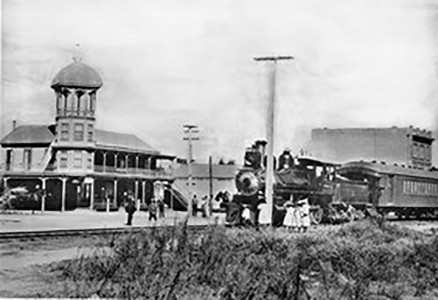
In 1886 and 1887, a fierce rate war between the Southern Pacific and Santa Fe railroads slashed passenger fares, triggering a wild land boom that drew a wave of opportunistic Midwestern speculators to the fledgling town of Long Beach. Dubbed "Escrow Indians," these migratory, slick-talking agents swarmed the town each summer, pressuring tourists into buying unseen parcels of land.
Their tactics ranged from high-pressure sales pitches to blatant fraud – such as tying fresh oranges to wild Joshua trees to market barren desert lots as flourishing citrus groves!
In late 1887, local real estate agents teamed up with Methodist Episcopal minister George M. Elwood to restore order. Together, they established Long Beach’s first professional real estate organization: the Real Estate Exchange, electing Elwood as its president (Press-Telegram, 5/6/1945).
Membership was restricted to established agents operating physical offices in Long Beach. To eliminate dishonest practices, the Exchange enforced strict rules: members were forbidden from handling properties listed by non-members, effectively boycotting unauthorized agents. The Exchange explicitly vowed to "go to the root of evil" and "tear up the system of curbstone brokerage by the roots."
With the collapse of the real estate market after 1888, it’s unclear how long the organization lasted. Between January 1, 1887, and July 1889, over sixty new towns were laid out in Southern California. But the summit was reached in 1888. After that the boom proceeded to skid downwards, a fact promoters tried to ignore. Long Beach was among the survivors.
In 1906, the Real Estate Exchange was renamed the Long Beach Realty Board, reviving efforts to oversee the market as conditions improved. The new board also targeted civic improvement, managing signs and pushing property owners to remove weeds from empty lots.
Municipal control grew stricter on December 24, 1912, when Long Beach enacted an ordinance charging realtors an annual $10 license fee (around $340 in 2025). The tax sparked immediate controversy. A. W. Mayell led the opposition, publicly arguing in the Daily Telegram (12/6/1912) that the fee was engineered by a "clique of men" trying to fix commissions and dismantle an open, "free-for-all" market.
Despite opposition, local licensing prevailed. In 1917, the Long Beach Realty Board helped spearhead the movement that led California to enact the nation’s first statewide real estate licensing law. That initial law was later declared unconstitutional, but a revised 1919 Realty Act was upheld by the California Supreme Court later that year. Formal written licensing examinations were not instituted until 1931.
In 1941, the Long Beach Realty Board applied for a new charter under the national association with a new name − the Long Beach Board of Realtors (Press-Telegram, 12/19/1941).
Category:
- Log in to post comments
Featured Video
Beachcomber
Copyright 2026 Beeler & Associates.
All rights reserved. Contents may not be reproduced or transmitted – by any means – without publisher's written permission.

